AI for Marketing: A Complete Guide for Beginners
Artificial intelligence is becoming an important part of modern marketing. Marketers can use AI to research audiences, generate content ideas, analyze data, personalize customer experiences, improve advertising workflows, and automate repetitive tasks.
But AI for marketing is not simply about asking an AI tool to create everything for you.
The real value comes from combining artificial intelligence, marketing knowledge, human judgment, reliable data, and creativity.
For beginners, the easiest way to understand AI in marketing is to think of it as a digital assistant. It can process information, identify patterns, generate ideas, summarize data, and support repetitive tasks. The marketer still needs to decide what the business should communicate, who it should target, and whether the final result is useful.
This guide explains how AI is used in marketing, its major benefits, common use cases, useful tools, limitations, practical workflows, and how beginners can start using AI effectively.
What Is AI for Marketing?
AI for marketing is the use of artificial intelligence technologies to support marketing research, planning, content creation, customer analysis, personalization, advertising, automation, and performance measurement.
Traditional marketing often requires marketers to manually collect information, analyze customer data, create content variations, and review campaign performance.
AI can assist with many of these activities.
For example, marketers can use artificial intelligence to:
- Generate blog topic ideas
- Analyze customer feedback
- Create advertising copy variations
- Summarize campaign data
- Identify patterns in customer behavior
- Generate social media ideas
- Develop audience segments
- Assist with keyword research
- Personalize email messages
- Automate repetitive marketing tasks
- Organize research
- Create content briefs
- Summarize reports
- Generate creative concepts
However, AI output still needs human review. An AI system can produce incorrect information, misunderstand context, or create generic content.
Therefore, effective AI marketing is not about removing marketers from the process. It is about helping marketers spend more time on strategy, creativity, decision-making, and optimization.
How Does AI for Marketing Work?
At a basic level, AI for marketing systems use data and algorithms to identify patterns and generate useful outputs.
A simple process looks like this:
Data → AI processing → Insights or output → Human review → Marketing action → Measurement
For example:
Customer data → AI identifies patterns → Audience segments → Marketer reviews segments → Targeted campaign → Campaign results
Generative AI adds another capability. It can produce text, images, ideas, summaries, and other forms of content based on instructions and available information.
The quality of the output depends heavily on the quality of the information, context, and instructions provided.
This is why marketers should treat AI as an assistant rather than an automatic replacement for marketing expertise.
Why Is AI Becoming Important in Marketing?
Marketing has always involved a combination of creativity and data.
A marketer needs to understand customers, identify their problems, create messages, choose channels, launch campaigns, and measure results.
Many of these activities also involve repetitive work.
For example, a marketer may need to:
- Research a market.
- Study competitors.
- Analyze customer comments.
- Develop content ideas.
- Create multiple headlines.
- Write social media posts.
- Prepare advertising variations.
- Analyze campaign results.
- Create reports.
- Optimize the next campaign.
AI can support several of these steps.
This does not mean that every marketing task should be automated. Instead, marketers can decide where AI saves meaningful time and where human involvement is more valuable.
For example, generating 20 headline ideas may be an appropriate AI task, while deciding the company’s positioning may require deeper human judgment.
This distinction is important because successful marketing is not simply about producing more content. It is about producing the right message for the right audience at the right stage of the customer journey.
Benefits of AI in Marketing
There are several important Benefits of AI in Marketing, particularly for businesses and teams with limited time or resources.
1. Saves Time
One of the biggest advantages of AI is reducing repetitive work.
A marketer might spend considerable time creating headlines, organizing research notes, summarizing customer feedback, or converting one piece of content into different formats.
AI can assist with these initial tasks.
For example, one long-form article could be transformed into:
- LinkedIn post ideas
- Instagram captions
- Short-video concepts
- Email ideas
- Advertising copy variations
- Newsletter topics
- Video scripts
The marketer can then edit and improve the outputs instead of starting every asset from zero.
2. Helps Analyze Large Amounts of Data
Marketing generates information from websites, advertisements, social media platforms, CRM systems, surveys, and customer interactions.
AI can help marketers organize this information and identify patterns.
For example, a marketer might investigate:
- Which audience segment generates the most leads?
- Which campaign has the highest conversion rate?
- Which customer complaints appear repeatedly?
- Which content topics receive the most engagement?
- Which landing pages receive traffic but generate few conversions?
AI can help organize and interpret the information, while the marketer validates the conclusions before taking action.
3. Supports Personalization
Customers do not always have the same interests, needs, or purchasing behavior.
AI can help marketers organize audiences according to characteristics such as:
- Interests
- Previous interactions
- Purchase behavior
- Content engagement
- Location
- Customer lifecycle stage
- Previous purchases
This can make it easier to develop more relevant messages for different customer groups.
Instead of creating one generic message, marketers can develop different messages for different customer needs.
4. Generates Marketing Ideas
AI can work as a brainstorming partner.
For example, a marketer launching a fitness brand could ask for:
- Blog topics
- Social media concepts
- Video hooks
- Campaign themes
- Customer questions
- Promotional ideas
- Email topics
The marketer should not blindly publish the suggestions. Instead, AI-generated ideas should become starting points for original marketing concepts.
5. Improves Marketing Efficiency
AI can help marketers manage repetitive processes more efficiently.
This can be especially useful for freelancers, startups, and small businesses that cannot dedicate separate employees to every marketing activity.
Instead of replacing the entire marketing process, AI for marketing can support individual steps within that process.
6. Helps Scale Marketing Work
A small marketing team may need to manage multiple channels simultaneously.
For example:
- Website
- SEO
- Google Ads
- Meta Ads
- Content marketing
AI can help the team develop variations and organize information across these channels.
However, scaling output should not mean sacrificing quality.
A company that produces 100 low-quality pieces of content does not necessarily have a better marketing strategy than a company that produces 10 highly useful pieces.
How AI Is Used in Marketing
Artificial intelligence can support many major areas of digital marketing.
AI for Content Marketing
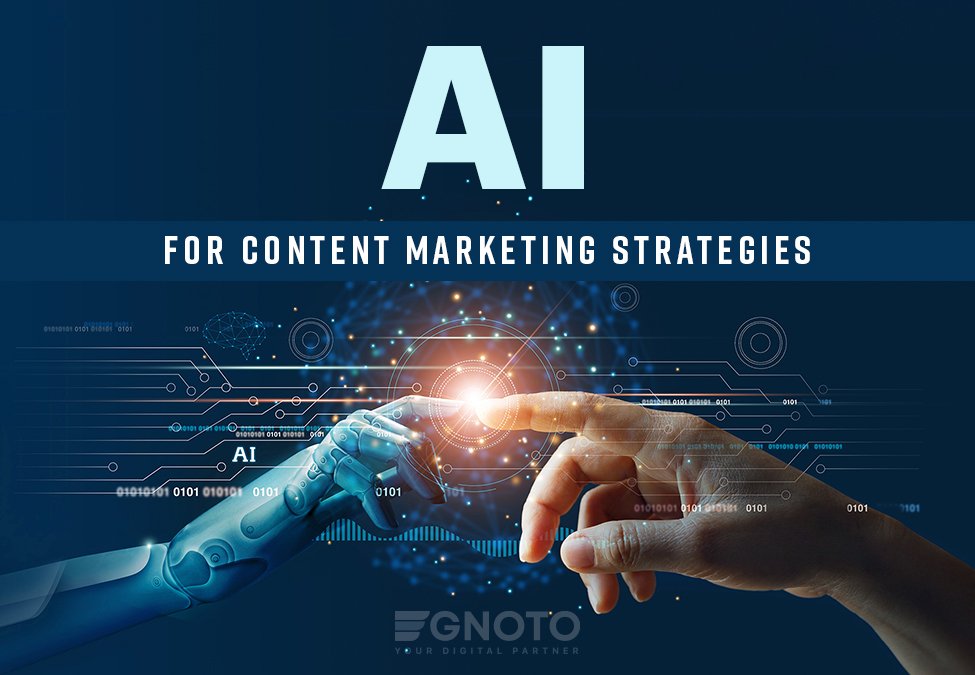
Content marketers can use AI to assist with:
- Topic research
- Content briefs
- Headlines
- Outlines
- Content repurposing
- Content summaries
- Audience questions
- Content calendars
- Editing and rewriting
- Content distribution ideas
For example, instead of asking an AI for marketing tool to immediately write an entire article, a marketer can provide the target audience, search intent, product information, existing research, and desired angle.
The AI can then help develop an outline.
The marketer adds original insights, examples, experience, research, and editorial judgment before publishing.
This creates a stronger foundation than simply publishing generic AI-generated content.
A Better AI Content Workflow
A practical workflow can look like:
Audience research → Search intent → Topic → Outline → Human research → AI assistance → Human editing → Fact checking → Publishing → Performance analysis
This workflow gives AI a supporting role while keeping quality control with the marketer.
AI for SEO
AI can assist SEO professionals with activities such as:
- Keyword clustering
- Search-intent analysis
- Content outlines
- Internal-link suggestions
- Title ideas
- Meta-description drafts
- Content-gap analysis
- Entity identification
- SERP question research
- Content optimization
For example, if the main topic is AI for marketing, related concepts could include:
- AI marketing tools
- Marketing automation
- Generative AI
- AI analytics
- Personalization
- AI advertising
- Customer segmentation
- AI content marketing
- AI marketing strategy
These related concepts help a writer build broader topical coverage.
However, SEO should not become an exercise in repeatedly inserting keywords.
A better approach is to ask:
What information does someone searching this topic actually need?
For example, someone searching for AI for marketing may want to understand:
- What it means
- How it works
- Why businesses use it
- Which tasks AI can handle
- Which tools exist
- How to get started
- What risks exist
- Whether AI will replace marketers
Covering these questions naturally creates stronger topical relevance.
AI for Marketing In Social Media
Social media marketers can use AI to assist with:
- Content ideas
- Caption drafts
- Content calendars
- Audience research
- Video hooks
- Post variations
- Comment categorization
- Performance summaries
- Content repurposing
For example, a marketer can turn one detailed blog post into several social media concepts.
A single article could become:
LinkedIn: Educational post
Instagram: Carousel concept
Short video: 30-second educational script
X: Short insight or discussion prompt
Email: Newsletter summary
AI can help with the transformation, while the marketer adjusts each version according to the platform and audience.
The goal is not to copy the exact same content everywhere.
Each platform has different user expectations and communication styles.
AI for Paid Advertising
AI is increasingly being integrated into advertising workflows.
Marketers can use AI-assisted processes for:
- Ad copy variations
- Creative ideas
- Audience analysis
- Campaign insights
- Performance summaries
- Testing concepts
- Budget analysis
- Landing-page ideas
For Google Ads or Meta Ads, AI for marketing can help marketers develop multiple messaging variations.
For example, instead of developing one headline, a marketer might create several concepts based on:
- Problem
- Benefit
- Feature
- Price
- Convenience
- Trust
- Urgency
The marketer can then test appropriate variations.
However, marketers still need to monitor important metrics such as:
- Click-through rate
- Conversion rate
- Cost per acquisition
- Return on ad spend
- Lead quality
- Revenue
The objective is not simply to create more advertisements. The objective is to improve marketing performance and business outcomes.
AI for Email Marketing
Email marketers can use AI for:
- Subject-line ideas
- Email drafts
- Personalization
- Customer segmentation
- A/B-test ideas
- Campaign summaries
- Follow-up sequences
- Re-engagement ideas
For example, instead of sending exactly the same message to every customer, a business could create different communications for:
- New leads
- Existing customers
- Previous customers
- Inactive customers
- High-value customers
AI for marketing can assist with these variations, but marketers should verify that the messaging is accurate and appropriate.
AI for Customer Research
Customer research is another useful application of AI.
AI can help organize:
- Survey responses
- Reviews
- Customer complaints
- Interview notes
- Social comments
- Frequently asked questions
- Support conversations
Suppose a company has hundreds of customer comments.
Instead of manually reading every comment to identify common themes, AI can help categorize them into areas such as:
Price → Product quality → Delivery → Customer support → Product features
A marketer can then investigate these themes and use the findings to improve marketing or product decisions.
This is particularly useful because customer feedback often contains valuable language that can be reused to understand how customers describe their own problems. AI for marketing
AI for Marketing Analytics
Marketing analytics involves turning campaign data into useful decisions.
AI can assist with:
- Data summaries
- Trend identification
- Anomaly detection
- Report generation
- Performance comparisons
- Customer segmentation
- Forecasting scenarios
For example, if website traffic increases while conversions decrease, AI can help a marketer investigate possible explanations.
Possible areas to investigate could include:
- Traffic quality
- Landing-page performance
- Mobile experience
- Form completion
- Offer relevance
- Audience targeting
- Conversion tracking
However, the AI’s interpretation should always be checked against the original data before important decisions are made.
AI should help ask better questions—not replace analytical thinking.
AI for Marketing Customer Segmentation
Customer segmentation means dividing a broader audience into smaller groups based on meaningful characteristics.
Traditional segmentation may use information such as:
- Age
- Location
- Gender
- Purchase history
- Interests
- Customer type
AI for marketing can help identify patterns across multiple variables.
For example, a business may discover that customers who repeatedly visit educational content before purchasing behave differently from customers who arrive directly through product pages.
These groups could potentially require different communication.
AI for marketing role is to determine whether the identified pattern is meaningful and whether it should influence the campaign.
AI For Marketing Personalization
Personalization means adapting marketing experiences to different users or groups.
Examples include:
- Personalized email recommendations
- Product recommendations
- Different website messages
- Customized offers
- Relevant content suggestions
- Audience-specific advertisements
AI can help process customer signals and determine which information may be relevant.
However, personalization should provide value rather than feel intrusive.
There is a difference between:
“Here is content related to something you previously viewed.”
and:
“We know everything about you.”
Good personalization should make the customer experience more useful, not uncomfortable.
AI For Marketing Tools
The right tool depends on the marketing problem you are trying to solve.
Instead of choosing a tool simply because it is popular, first identify the task that needs improvement.
| Marketing task | AI can assist with |
|---|---|
| Content | Ideas, outlines, drafts, editing |
| SEO | Keyword grouping, briefs, content analysis |
| Social media | Captions, ideas, calendars |
| Advertising | Copy variations, creative concepts |
| Subject lines, personalization, drafts | |
| Analytics | Summaries, patterns, reporting |
| Design | Creative concepts and visual generation |
| Research | Summarization and categorization |
| Automation | Repetitive workflows and task handling |
Common categories include:
- Generative AI assistants
- SEO platforms with AI features
- Analytics tools
- Advertising-platform AI features
- Design applications
- CRM platforms
- Marketing automation systems
- Customer-support AI
- Research assistants
The important question is not:
A better question is:
“Which marketing problem am I trying to solve?”
How to Choose an AI For Marketing Tool
Before adopting an AI tool, consider five questions.
1. What problem does it solve?
Do not buy or use a tool simply because it has AI features.
Identify the actual problem first.
2. Does it fit your workflow?
A for marketing tool may have impressive features but still create unnecessary complexity.
3. Can you verify its output?
For marketing, accuracy matters.
You should be able to review and validate important outputs.
4. Does it protect your data?
Understand what information you are sending to the platform and what policies apply.
5. Does it improve an actual business metric?
Time savings are useful, but the ultimate goal is better marketing performance.
How to Use AI in Marketing: A Beginner Workflow
If you are new to AI for marketing, start with a simple five-step process.
Step 1: Define the Marketing Goal
Do not start with the AI tool.
Start with the business objective.
For example:
Increase qualified leads from Google Search.
That goal is more useful than:
Use AI for SEO.
A clear objective helps you determine where AI can actually provide value.
Step 2: Collect Reliable Information
Give the AI relevant context.
This might include:
- Target audience
- Product information
- Customer problems
- Brand voice
- Existing content
- Campaign data
- Competitor information
- Business objectives
Better input generally produces more useful output.
Step 3: Ask AI for Assistance
Instead of requesting a finished result immediately, break the task into stages.
For example:
Research → Ideas → Outline → Draft → Review → Improve
This gives you more control over the final result.
Step 4: Apply Human Judgment
Review everything before using the output.
Check:
- Accuracy
- Brand voice
- Originality
- Facts
- Examples
- Customer relevance
- Claims
- Grammar
- Context
AI should assist the marketer, not become the final decision-maker.
Step 5: Measure the Result
After publishing content or launching a campaign, measure what happened.
Depending on the campaign, useful metrics could include:
- Organic traffic
- Leads
- Conversion rate
- Engagement
- Cost per lead
- Customer acquisition cost
- Revenue
- Return on ad spend
Then use the results to improve the next marketing cycle.
How to Write Better AI Prompts for Marketing
The quality of an AI response often depends on the instructions you provide.
A weak prompt might be:
Write a blog about SEO.
This gives the AI very little context.
A stronger prompt could include:
- Role
- Target audience
- Business
- Topic
- Search intent
- Desired tone
- Content format
- Important information
- Restrictions
For example:
Act as an SEO content strategist. Create an outline for beginners aged 19–35 who want to learn SEO. The article should explain keyword research, search intent, on-page SEO, internal linki